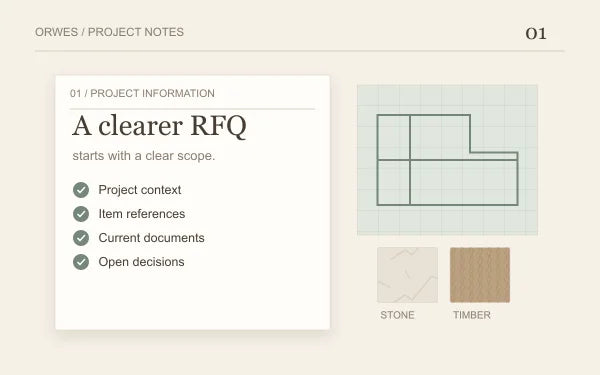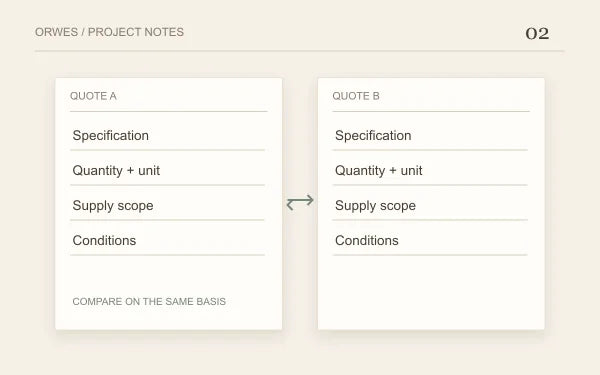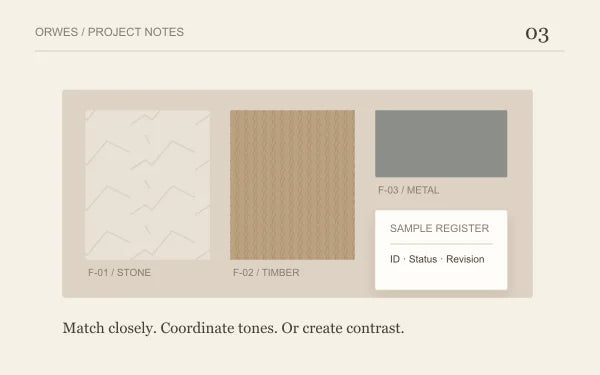
PROCUREMENT GUIDES / 04
What to Confirm Before Placing a Building Materials Order
Bring specifications, quantities, finishes and supporting documents together before committing to an order.
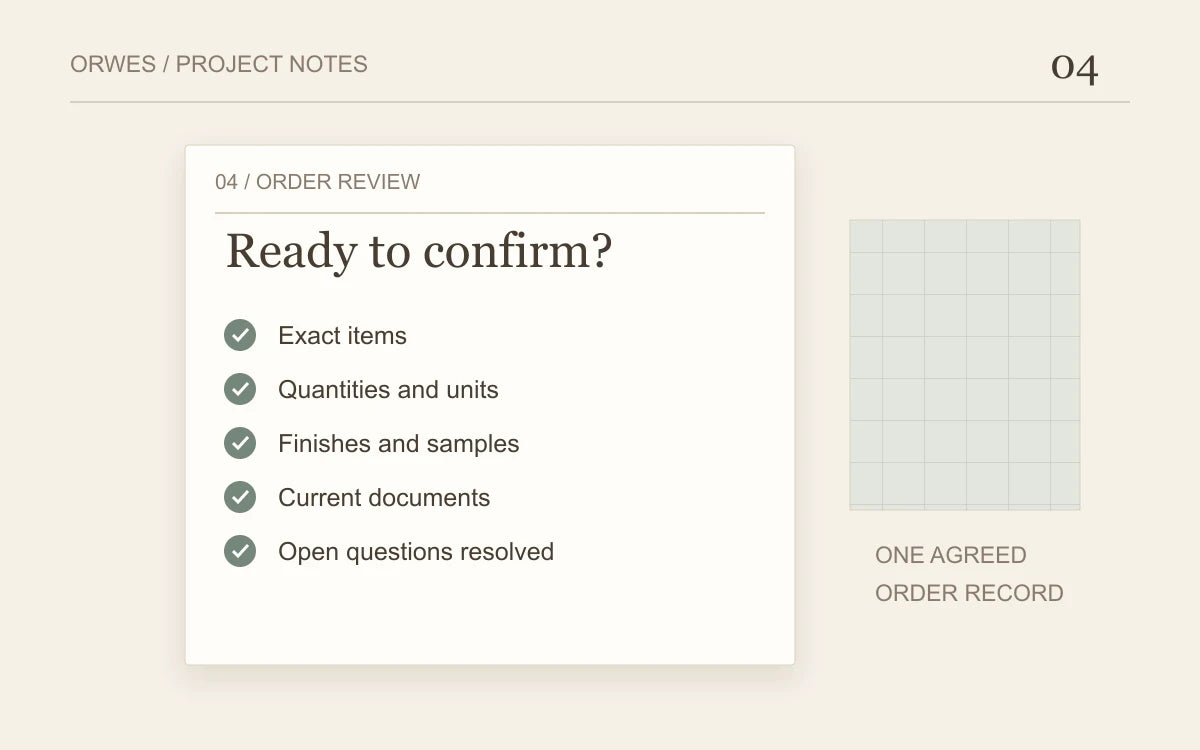
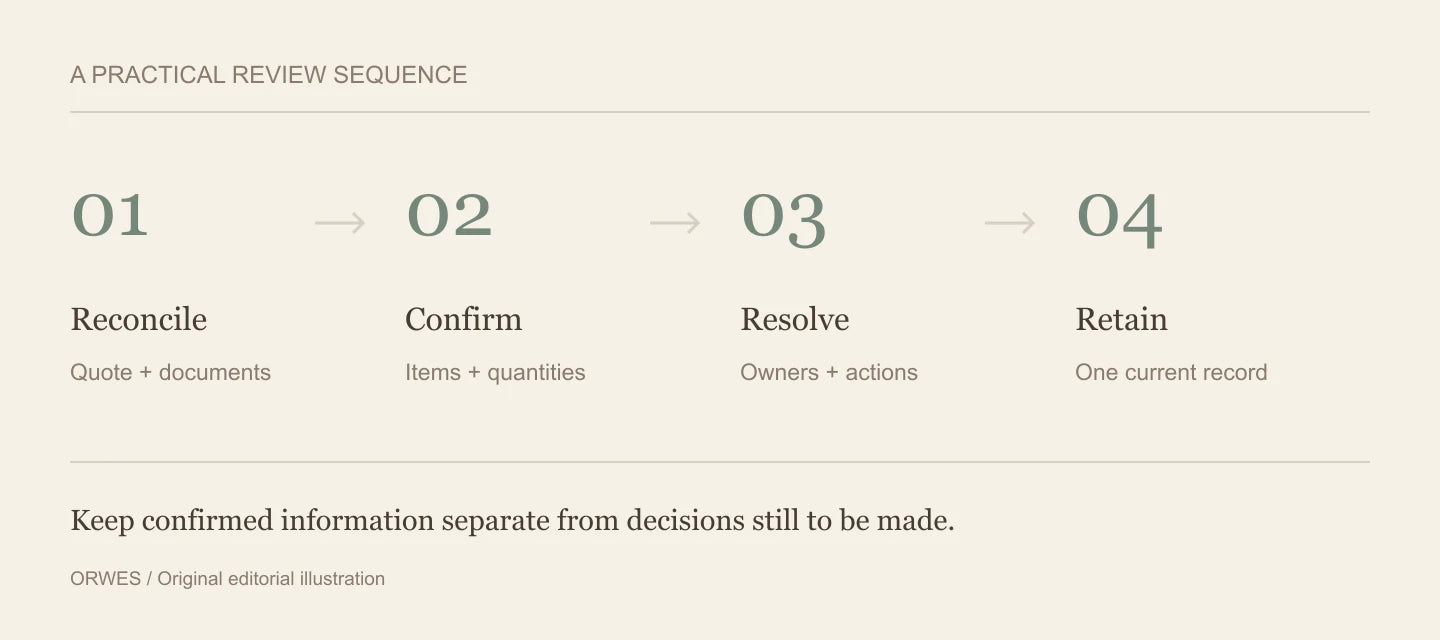
Before placing a building materials order, check that the selected quotation, product details, quantities and supporting documents describe the same agreed scope. Any unresolved choice should be visible and assigned to someone who can confirm it.
This review does not need to be complicated. Its purpose is to make sure the purchasing decision reflects the project’s current requirements rather than an earlier drawing, an assumed finish or an incomplete conversation.
For builders, designers and developers, a short written checklist provides a useful final check before committing to the order.
1. Confirm the exact items being ordered
Review the item references and descriptions against the current material schedule.
Check the product type, model or configuration where relevant, dimensions, finish and any accessories included in the supply. If an alternative has been selected, make sure the order describes that alternative rather than retaining the original description.
Do not rely on a broad category name where the project requires a specific configuration.
Also check whether the quotation has changed during discussions. A revised selection may affect more than one line item, so it is useful to review the order as a whole.
2. Check quantities and units
Confirm the quantity and unit for each item.
Be clear about the difference between a piece, set, carton, linear metre and square metre. If a set contains several components, record what is included.
Check whether quantities are final or still awaiting confirmation. If allowances or spare items have been included, identify them separately where practical.
Record who is responsible for the quantities and any measurements on which they depend. A quotation based on a supplied quantity does not automatically mean that the quantity or the site measurement has been independently checked.
Where information is still preliminary, agree how it will be resolved before the relevant commitment is made.
3. Identify the documents that apply
List the drawings, schedules and other documents that define the order.
Include document numbers or titles, revisions and dates. This helps everyone distinguish the selected information from earlier versions.
If a marked-up drawing or written clarification changes a requirement, make sure it is included in the order record. Avoid leaving a significant decision in a separate email thread that is not referenced elsewhere.
Where documents contain conflicting information, resolve the conflict explicitly. Do not assume that another party will know which dimension, finish or note should take priority.
4. Confirm finishes and samples
Connect the order to the agreed finish references and sample register and any relevant sample records.
Check that a finish has moved from a proposed selection to a confirmed selection before treating it as final. Where confirmation has conditions, keep those conditions visible.
Be clear about what the sample review covered. An appearance sample may confirm colour or texture without confirming dimensions, installation requirements or technical suitability.
If the product or finish has changed since the sample was reviewed, ask whether a further review is required.
5. Review delivery requirements and open dependencies
Confirm the nominated delivery destination and the intended delivery arrangement.
If the order is to be supplied in stages, identify how those stages are defined. Room, level, building or programme references should be understandable to the people preparing and receiving the materials.
Check the timing basis and the actions that must happen first. An indicative date may still depend on final information or another agreed milestone.
Also review known receiving constraints, such as site access, storage availability and arrangements for accepting the delivery. Record which responsibilities have been agreed and which remain open.
6. Check the commercial details
Before accepting the selected quotation, review its date, revision, validity and stated conditions.
Confirm the currency and GST treatment where applicable. Check the payment arrangements and what the quoted delivery scope includes.
Where changes have been discussed, request an updated record that reflects the agreed position. This is easier to follow than relying on several separate messages that amend different parts of the quotation.
If a particular warranty or after-sales arrangement is important to the decision, obtain the relevant product-specific information rather than assuming one policy applies to every item.
For a smart toilet selection, record the exact model, required configuration and installation information you need confirmed. A product photograph or a broad description is not a substitute for the agreed item reference.
7. Use a final order checklist
The following checklist can be adjusted to suit the materials and project.
| Check | What should be clear before proceeding |
|---|---|
| Selected quotation | Correct date, revision and agreed scope |
| Product details | Item references, descriptions and configurations |
| Dimensions | Required sizes and responsibility for confirming measurements |
| Quantities | Amounts, units, allowances and spare items |
| Finishes | Current selections and relevant sample references |
| Documents | Applicable drawings, schedules, revisions and clarifications |
| Delivery | Destination, staging and agreed receiving arrangements |
| Timing | Relevant milestones, prerequisites and current status |
| Commercial details | Currency, GST treatment where applicable, payment and validity |
| Unresolved items | Named owner, required action and effect on the order |
| Final confirmation | A record that the relevant project contacts have reviewed the details |
Not every field will apply to every purchase. What matters is that missing information is recognised rather than silently treated as confirmed.
8. Keep the agreed order record together
Once the details are confirmed, retain the quotation, order, relevant documents and written clarifications in one accessible location.
If a change is needed afterwards, describe the change clearly and ask for its effect on scope, cost and timing to be confirmed before assuming it can be incorporated.
A final review cannot remove every project risk. It can help the team act on the same information and avoid preventable misunderstandings at the point of purchase.
If you would like to discuss your material requirements with ORWES, bring your current schedule, drawings and outstanding questions. Use them to identify which details still need confirmation before a purchasing decision is made.