PROCUREMENT GUIDES / 01
How to Prepare a Building Materials RFQ for an Australian Project
A practical starting point for requesting a useful quotation, even when some project decisions are still open.
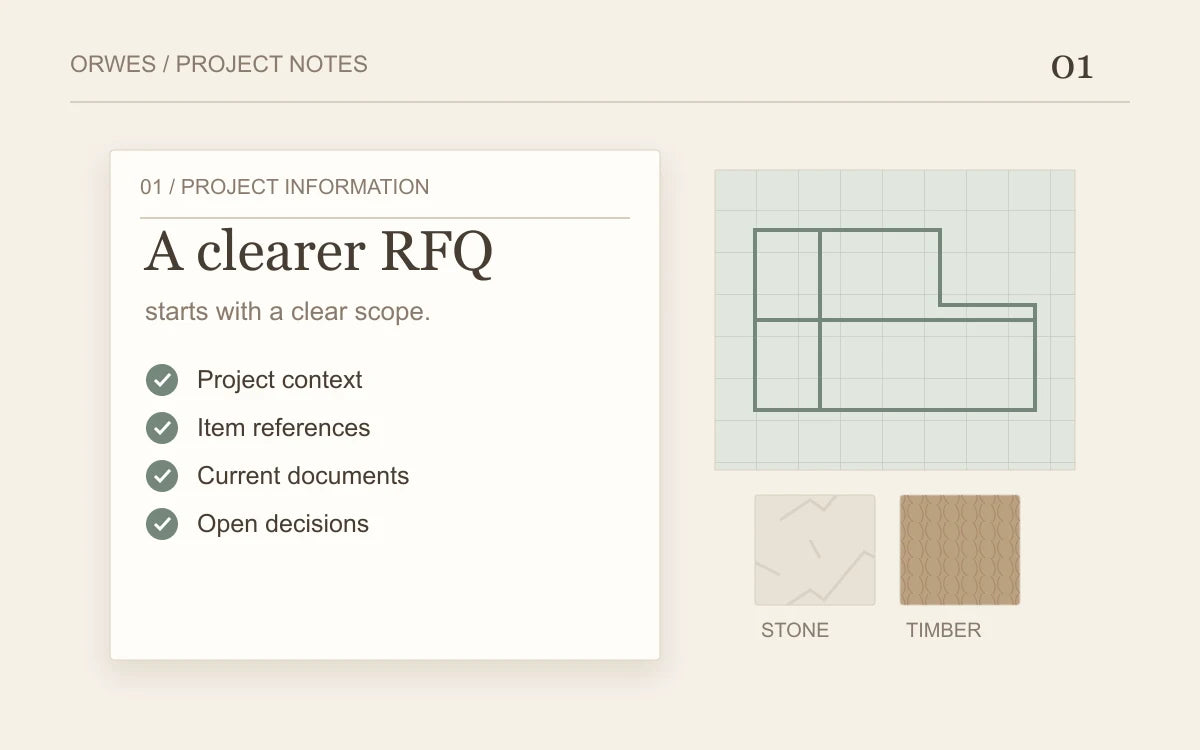
A useful building materials request for quotation, or RFQ, explains what your project needs, what has already been decided and what still requires clarification. It gives the recipient enough information to prepare a meaningful response without guessing at the scope.
You do not need a fully completed design package to start a conversation. An early enquiry can help identify missing information. The important distinction is between asking for an initial indication and requesting a quotation for a clearly defined order.
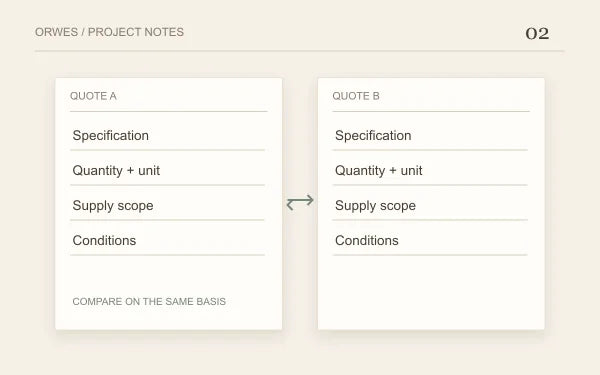
For builders, designers and developers, a structured RFQ also makes the next stage easier: comparing responses on the same basis.
1. Start with the project and the purpose of the enquiry
Begin with a short project summary. Include the project location, building type, current stage and the materials you want to discuss.
Explain whether you are exploring options, preparing a budget, pricing a tender or moving towards an order. A response based on preliminary information should not be treated as though every specification and commercial detail has been settled.
Useful background includes:
- Project location and delivery destination.
- Building type and approximate project scale.
- Current design or construction stage.
- Material categories included in the enquiry.
- Target dates and any known programme constraints.
- Main contact and the people involved in technical decisions.
You can keep this introduction brief. Its purpose is to help the recipient understand the context behind the material list.
2. Describe each material clearly
Give each item a reference that can be used consistently in drawings, schedules and correspondence. A room name alone may be too broad if several products are required in the same space.
For each item, include the information you already have: product type, dimensions, material, finish, quantity and any relevant requirements.
Where a specification is incomplete, say so. “Finish to be selected” is more useful than leaving a blank field that could be mistaken for an unrestricted choice.
If alternatives are welcome, identify what may change and what must remain the same. For example, you may be open to a different finish while keeping the nominated dimensions and installation arrangement.
This helps avoid receiving an alternative that looks suitable at first but changes other parts of the project.
For a bathroom material package, separate the basin, tapware, toilet and accessories into individual references. If you are considering smart toilets, identify the required model and installation arrangement rather than using a single line labelled “toilet”.
3. Attach the relevant drawings and schedules
Drawings can explain information that is difficult to communicate in a product list. Attach the documents relevant to the enquiry and identify their revision and date.
Make it clear which document should be used if several versions are included. Avoid sending a folder containing old and current drawings without guidance.
A simple document register can list:
- Document title or number.
- Revision.
- Issue date.
- Purpose of the document.
- Any sections that remain under review.
Also state whether quantities have been provided by your team or whether you are asking the recipient to review them. Do not assume that sending drawings automatically includes a quantity take-off or a check of site dimensions.
4. Explain quantities and delivery needs
State the unit used for every quantity. Pieces, sets, cartons, linear metres and square metres are not interchangeable.
Where relevant, explain whether the quantity is preliminary or confirmed, and whether spare material has been included. Any allowance should be visible rather than hidden in an unexplained total.
Include the delivery destination and indicate whether you expect one shipment or staged deliveries. If the programme is still developing, share the current target and label it accordingly.
Site access, storage limitations and receiving arrangements may affect the proposed delivery approach. You do not need to resolve every detail in the first enquiry, but known constraints should be raised early.
5. Ask for assumptions and exclusions to be visible
An RFQ should explain how you would like the response presented.
Ask the recipient to identify what is included, what is excluded and which assumptions have been used. This is especially helpful where the specification is incomplete or the requested scope crosses several material categories.
The response should make clear the quoted items, quantities, pricing basis, delivery scope, relevant conditions and any information still needed.
For Australian projects, ask that the currency and GST treatment are stated clearly where applicable. Do not assume that two quoted totals include the same charges.
6. Use a short checklist before sending
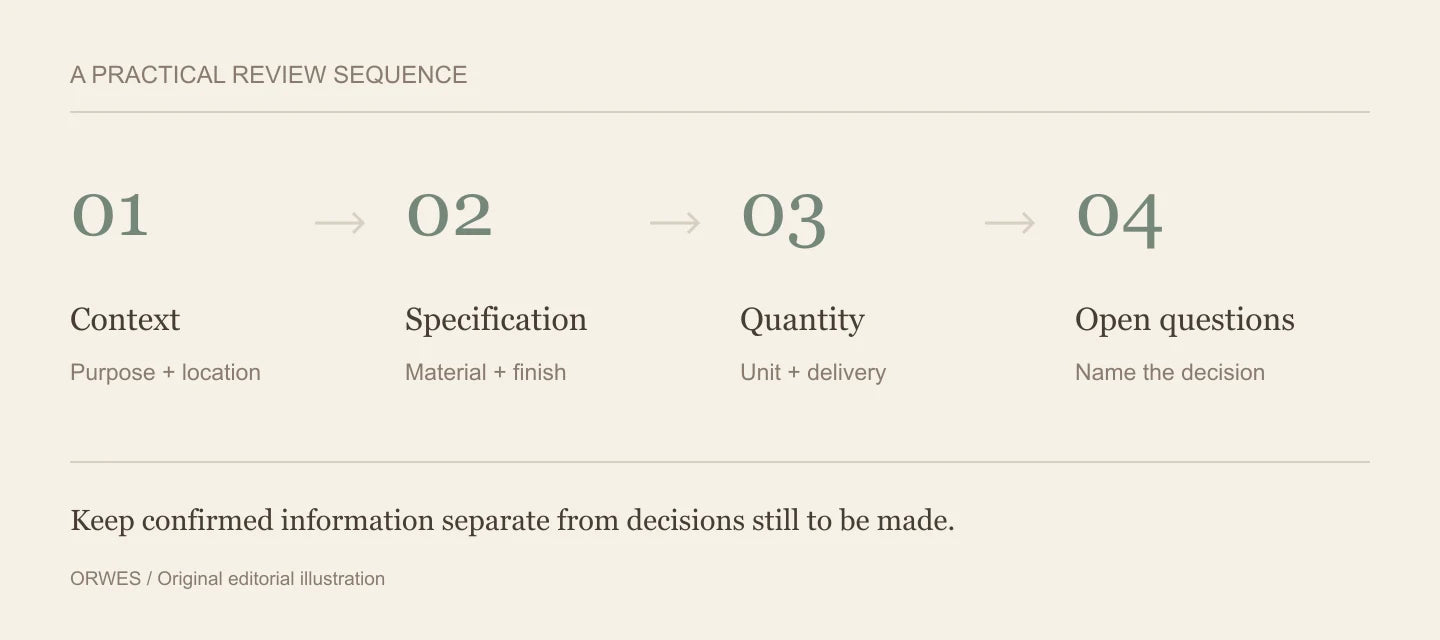
The following checklist can be copied into your enquiry preparation process. It is a starting point and can be adjusted to suit the project.
| Information | What to include | If it is not yet confirmed |
|---|---|---|
| Project context | Location, building type and current stage | State the current working assumptions |
| Enquiry purpose | Budget review, tender pricing or order preparation | Explain what decision the response will support |
| Material list | Item references, descriptions and categories | Mark incomplete items clearly |
| Specifications | Dimensions, materials, finishes and relevant requirements | List the decisions still required |
| Quantities | Amount, unit and whether allowances are included | Label estimates as preliminary |
| Drawings | Relevant documents, revisions and dates | Identify documents still under review |
| Delivery | Destination, target dates and staging needs | Separate targets from confirmed requirements |
| Response format | Included scope, exclusions and assumptions | Ask for clarification rather than silent assumptions |
| Contacts | Commercial and technical contacts | Nominate one person to coordinate questions |
What happens after the RFQ is sent?
Keep clarification questions in one place. If the scope changes, issue the update to everyone whose response needs to remain comparable.
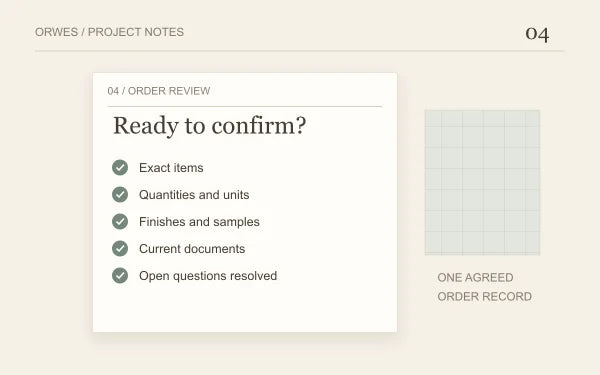
A clearer RFQ does not remove every question. It creates a shared starting point and makes unresolved issues easier to identify before you reach the final order review.
If you would like to discuss your material requirements with ORWES, start with a material list, relevant drawings and an outline of your timing. Note what is confirmed and what is still being developed so the scope of the conversation is clear from the beginning.