PROCUREMENT GUIDES / 02
How to Compare Building Material Quotes Beyond Unit Price
Make differences in specifications, quantities and delivery assumptions visible before choosing a quotation.
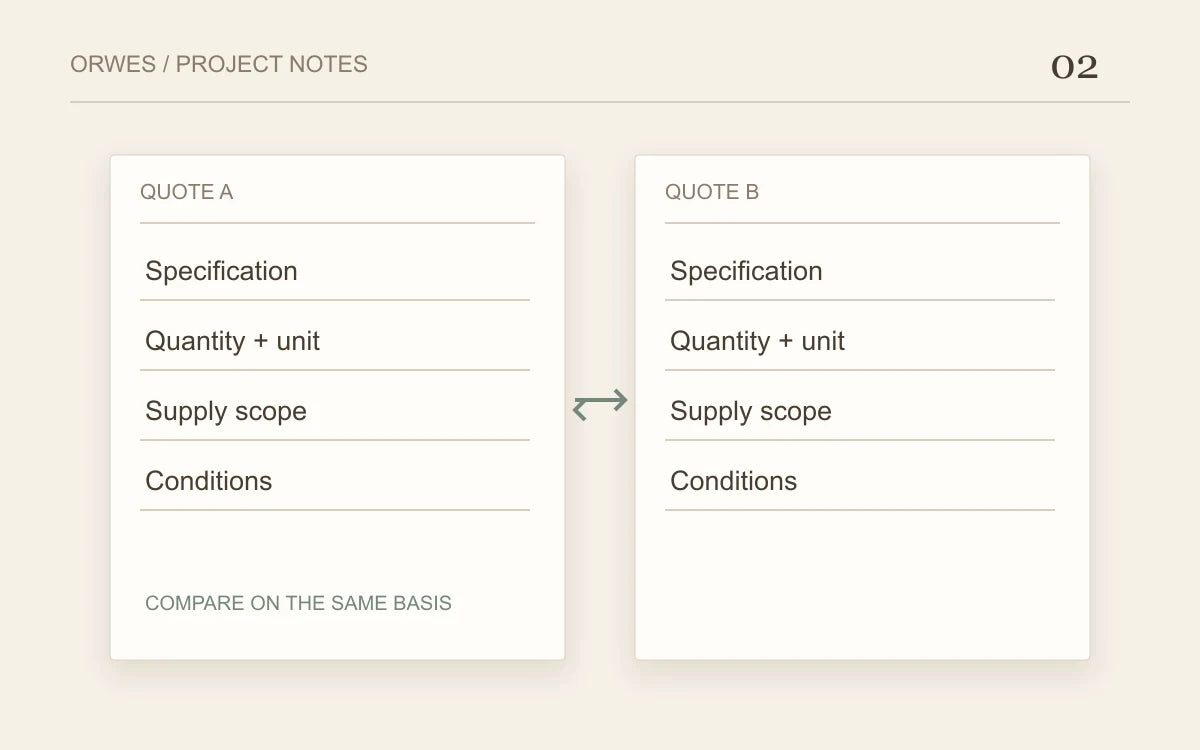
To compare building material quotes fairly, first check that they cover the same products, quantities and supply conditions. A lower unit price is useful information, but it does not explain whether two quotations offer the same scope.
For builders and developers, the comparison also needs to account for what remains unresolved. An unclear exclusion, an assumed finish or a delivery arrangement that does not suit the project can change the decision.
A practical comparison makes those differences visible before an order is placed.
1. Set a common comparison basis
Choose the specification, material schedule and drawing revision against which the quotations will be reviewed.
Record the reference documents at the top of your comparison sheet. If a quotation was prepared against an older revision, ask for the differences to be checked.
Then confirm whether each response is for the requested item or an alternative. An alternative may be worth considering, but it should be identified and reviewed as a different proposal.
Do not combine an original specification and a substituted product in the same comparison without explaining the distinction. Otherwise, an apparent price advantage may simply reflect a different material or configuration.
2. Check the product description and quantity
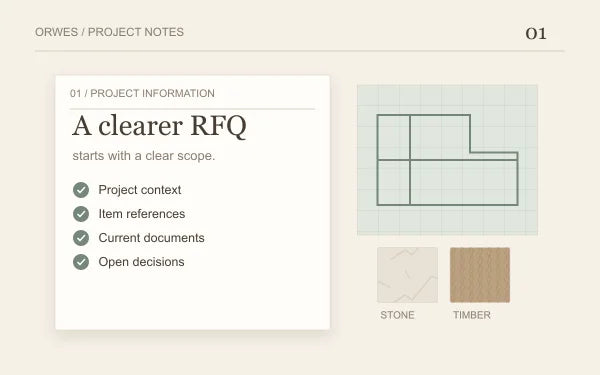
Match the item references in each quotation to the material schedule prepared for your RFQ.
Review dimensions, material, finish, configuration and any accessories that form part of the required supply. A short description may leave important differences hidden.
Check the pricing unit as well. A price per piece cannot be compared directly with a price per set unless you know what the set contains.
Useful questions include:
- Does the quoted quantity match the current schedule?
- Are accessories included or listed separately?
- Is the finish the requested finish or an assumed selection?
- Are spare items included?
- Has any minimum order or packaging quantity affected the total?
- Are there items on your schedule that have not been priced?
Resolve these points before ranking quotations by total price.
The comparison basis also needs to suit the category. For kitchen materials, a quotation for a sink alone covers a different scope from one that also lists cabinetry, a worktop or associated hardware. Record each required item separately; do not assume a category heading includes everything shown on a drawing.
3. Separate product price from the wider supply scope
A quotation may cover products only, or it may include additional elements. Those elements need to be stated rather than inferred.
Review packaging, transport and the agreed delivery point. Where relevant, clarify who is responsible for arranging and paying for other parts of the journey.
Ask how samples, documentation or other requested support are treated. Their inclusion should not be assumed simply because they were discussed earlier.
If a charge has not been confirmed, record it as an open item. Entering zero can make an incomplete quotation appear more competitive than it is.
4. Review delivery assumptions and timing
A date in a quotation may depend on several earlier actions. It could be conditional on final specifications, approved drawings, receipt of payment or another agreed milestone.
Ask what starts the stated timing and what event the date describes. Production completion, dispatch and arrival at the nominated destination are different milestones.
Also consider whether the proposed delivery sequence suits the project. A single delivery may be workable for one site and difficult for another with limited storage.
The aim is to understand the conditions behind the proposal. Do not treat a preliminary timing indication as a confirmed project commitment.
5. Make exclusions and open questions easy to see
Use separate fields for included items, excluded items and matters awaiting clarification.
This avoids a common comparison problem: treating missing information as though it has already been resolved in your favour.
If an item is excluded, consider whether it will be arranged elsewhere and whether that affects coordination or cost. If an item is unclear, ask a direct question and retain the response with the quotation.
Keep the revised quotation and its clarification record together. A decision should not depend on someone remembering a phone conversation that the rest of the project team cannot see.
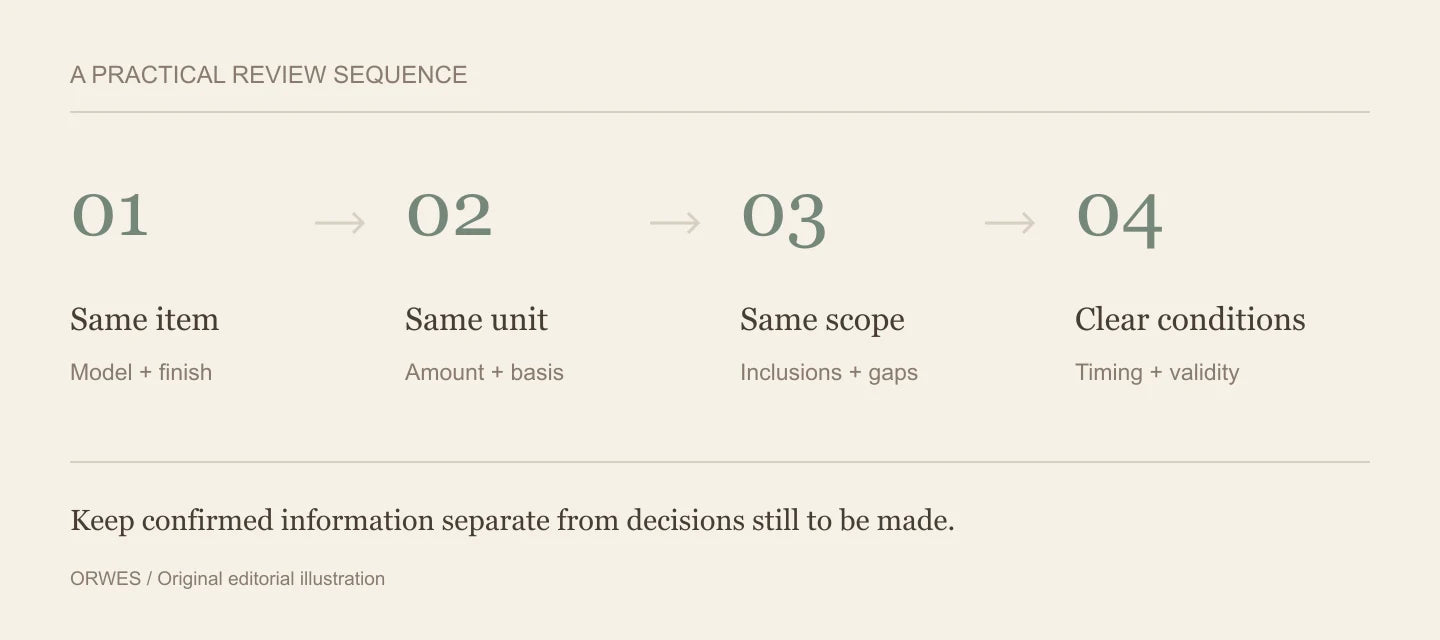
6. Use a consistent quotation comparison table
You can adapt the following table to the material category and size of the order.
| Comparison point | Quote A | Quote B | Action required |
|---|---|---|---|
| Quotation date and revision | Record reference | Record reference | Confirm both are current |
| Product and specification | Record quoted item | Record quoted item | Identify differences |
| Quantity and pricing unit | Record amount and unit | Record amount and unit | Put on a common basis |
| Finish and configuration | Record confirmed details | Record confirmed details | Clarify assumptions |
| Accessories and spare items | Included, excluded or unclear | Included, excluded or unclear | Check against requirements |
| Packaging and delivery scope | Record agreed scope | Record agreed scope | Confirm delivery point |
| Currency and GST treatment | Record stated basis | Record stated basis | Clarify where necessary |
| Timing and prerequisites | Record milestone and conditions | Record milestone and conditions | Check against programme |
| Payment and quotation validity | Record stated terms | Record stated terms | Review before accepting |
| Remaining questions | List unresolved items | List unresolved items | Obtain written clarification |
Avoid scoring the quotations until the differences are understood. A numerical ranking can give a false sense of precision if major parts of the scope remain unknown.
7. Record why the selected option suits the project
The final decision may involve price, specification, timing, delivery arrangements and the level of unresolved risk.
Record the reasons for the choice, particularly where the selected quotation is not the lowest. This helps the project team understand which conditions mattered and which trade-offs were accepted.
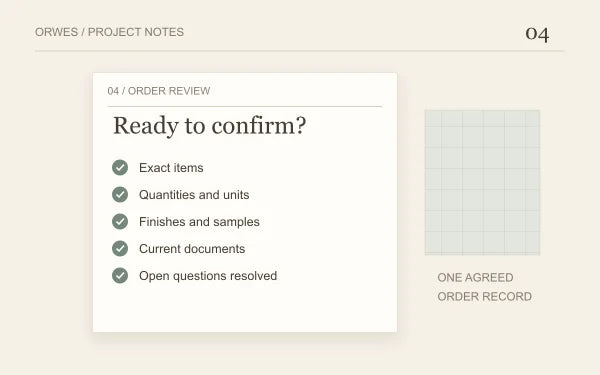
Before placing the order, confirm that the selected quotation still reflects the agreed scope and current documents.
When discussing materials with ORWES, identify the material references, required quantities and supply boundaries you want clarified. A clear comparison starts with knowing what the project requires and making any differences explicit.